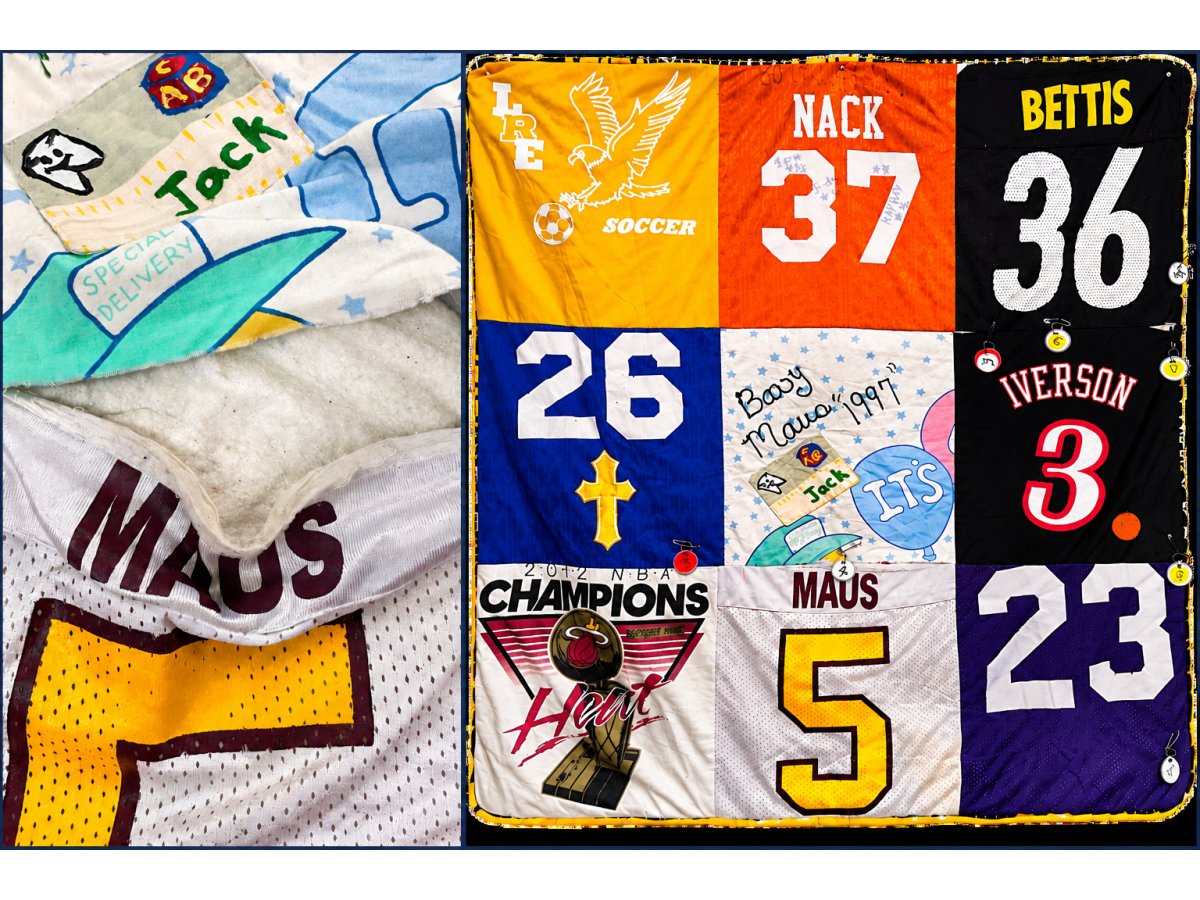
Yes, you can improve an unquilted “quilt” or blanket by adding traditional quilt elements: batting and a backing can be added, and then, most importantly, stitching–quilting the layers together. Our commissioned quilts have four layers: a top, a stabilizing layer, an insulating middle, and a backing. By contrast, a T-shirt blanket is often made by sewing shirt squares together without interfacing or the insulating middle layer and no quilting. Once the squares are sewn together the completed top is serged or sewn to the existing back around the edges. There is no binding fabric that neatly finishes those outer edges after quilting.
With your approval we will take apart an incomplete quilt and remake it.
When shirts hold memories, it makes sense to want a finish that feels as considered as the pieces themselves. The right makeover can add warmth, texture, and structure, but the best approach depends on how the blanket is made and the condition of its fabric. This guide explains how T-shirt quilts are constructed, how quilting affects durability, and which unquilted blankets and existing quilts may suit a makeover. You’ll also find practical criteria to help decide whether adding quilting is the right next step.
T-shirt blanket construction and materials
A T-shirt blanket joins shirt squares, usually without interfacing, batting or the layers quilted together. The shirts preserve their original colors and graphics, but an unquilted single fabric layer may stretch over time and provides less definition for the quilting and insulation than a quilt. An example of this is shown on the cover picture. A Mom made this small blanket many years ago for her son. The stretching is evident on the picture on the right. There is an unquilted batting layer in the middle that can be seen on the left. Over time some holes developed. The larger hole is where the batting is poking through. There were also lumps where the batting had shifted with use. This will happen if there is nothing holding the layers together. She brought it to us for an assessment for repairs and possible quilting.
Can you improve on an unquilted "quilt" or blanket? Yes. A t-shirt quilt combines a pieced or solid top, interfacing, batting, and backing. Quilt stitching in the design of your choice holds the layers together, adds texture, and keeps all layers in place, eliminating stretching. We like t-shirts because they are comfortable, move with us and stretch to conform to our shape. We want your t-shirt quilt to be comfortable and durable but not stretch with use, over time as in our pictured example.
To quilt a blanket, we use its existing top and add interfacing where indicated, batting and backing suited to its weight and the desired outcome of the owner. We use commercial batting designed for use in quilts. A flat flannel sheet is a thinner option for the back for a summer quilt. Whether added warmth and stitched structure are right for you depends on how you plan to use the piece. The back used in our example is fleece.
We provide long arm quilting. This uses a specialized machine to transfer the design of your choice, in the thread of your choice through all layers of the soon to be finished quilt. Alternatives to long arm quilting include tying or tacking the layers by hand. Embroidery floss or yarn can make evenly spaced knots without stitched quilting lines. On the makeovers we do with older quilts, we see ties less often now. Removing them is often part of makeovers on quilts that can benefit from quilting. A regular sewing machine can quilt a thick blanket if the layers fit beneath its presser foot and feed smoothly. Bulky materials can make handling more difficult on a regular sewing machine.
There is no single maximum spacing that suits every batting. Follow the quilting-distance guidance for the batting you use, since its construction determines how far apart the stitching can be while keeping it secure. Batting in the middle with no quilting is not a good idea as the batting will shift and lumps will develop as happened in our pictured example. We flattened out the lumps and made all repairs. The customer did not want to add quilting as her son was now grown and the quilt was now a decoration and not being used at all.
Other bed coverings can also be made into a quilt. A coverlet can be a light decorative layer, often with a woven pattern and reversible design, offering easy layering and a tailored look. A duvet has a front, back, and filling, commonly down, feathers, or wool.
| Option | Layers and materials | Feel and finish |
|---|---|---|
| T-shirt blanket | Joined shirt squares; usually no batting or quilting | Stretchy, light and breathable |
| T-shirt quilt | Shirt top, interfacing, batting, fabric backing, quilting | Warmer, heavier, with stitched texture |
| Coverlet | One woven or printed layer that can be converted to a quilt | Light, often reversible |
| Duvet | Front, back, and filling. Can be converted to a quilt. | Warmth depends on filling |
Choose a T-shirt quilt makeover for added warmth and stitched structure; leave a blanket unquilted if it won’t be used much and you want a lighter, more breathable layer.
Durability and longevity
An unquilted T-shirt blanket joins shirt panels but has no quilting, interfacing or a batting layer. If batting is added but left unsecured without quilting, it will bunch or shift as in our example. Quilting or evenly spaced ties secure the layers, while sound seams and intact fabric help the finished piece stand up to regular use.
Quilting an existing blanket can cause puckering if t-shirt layers are not interfaced, move unevenly or the stitching pulls the fabric. Materials that respond differently to washing can also shrink unevenly and distort the shape. Before adding layers, check the seams and fabrics. Most t-shirts have already been washed a lot; but, if in doubt, test wash any questionable shirts and keep everything smooth during assembly. We will recommend any additional prep work that may be needed before quilting.
Batting affects both feel and wear. A thicker wool or fleece blanket used as batting can add warmth and definition to a hard-wearing picnic or car quilt, but it can also make the result heavier than cotton or a blend of cotton and polyester batting.
Decide how you’ll use the quilt. A lighter cotton quilt may suit summer, while a heavier decorative piece may work better as a bed topper or picnic layer. Heavy is nice in colder climates. For a quilted finish, keep the top, batting, and backing aligned as you stitch, then follow care suited to the fabrics. Careful construction supports the layers, but it cannot restore graphics already cut off from T-shirt panels.
Please check with us before cutting your t-shirts. If they are cut incorrectly for the style that you like it will be more expensive to add fabric back on to get them to the desired size.
For an existing quilt with worn seams or loose layers, explore quilt makeover options as a way to consider a more durable finish.
Duvets have a removable cover. This protects the duvet and is another consideration when choosing bedding, alongside the construction and care considerations relevant to blankets and quilts. We have quilted the front and back layers together on a duvet and added batting in order to make it a quilt. Once they are quilted together, of course, you cannot remove the cover!
Quilts and blankets suitable for a makeover
An unquilted T-shirt blanket may suit a makeover when the sewing is straight and its shirt panels and seams are in good condition. Quilting can secure the top, batting, and backing with stitched lines. These will be added if they don’t already exist. First, inspect the fabric for worn areas, or areas that have begun to stretch and check whether the panels lie flat enough to sew.
Check the graphics and overall condition of the shirts before going forward with a layout. Quilting or rearranging cannot restore an image already cut off at the edge of a shirt panel. Vinyl or thick paint that has started to chip will continue to do so. Assess how meaningful that shirt is to you. In some cases they can be remade or repaired.
Uncut T-shirts can provide larger blocks that can be sized to complete a design preserving the complete graphic. Additional pieces may also help balance colors or fill gaps in a revised pattern.
Weight helps determine whether a makeover suits your intended use. Batting can make a lightweight, unquilted blanket warmer, while thick batting and fabric can make the finished piece heavier. A summer layer and a winter bed quilt call for different levels of warmth. What if you prefer one and your partner prefers another? You’re warm natured and your partner likes the cold. We haven’t made one quilt with the halves two different thicknesses but can. Why not? Who wants to be the first? 😆
Machine sewing all quilt layers together is practical when the layers fit and feed evenly beneath the presser foot. Very bulky or uneven sections can complicate stitching and if the weight of the layers is unsupported it can cause distortion so assess the seams, thickness and support of the weight before assembly. A stable top with intact graphics provides a sound foundation; fragile fabric or badly cropped images limit what a makeover can preserve.
If you’re looking to give a treasured T-shirt quilt a more finished structure, explore quilt makeover options built around the condition and layout of the existing piece.
Both T-shirt blankets and T-shirt quilts can be customized with selected shirts, colors, and designs. Consider which graphics you want to feature and how they fit with the existing piece. Choosing these elements together can guide a revised arrangement while keeping the focus on the fabric and images you want to preserve.
Just T-Shirt Quilts: Freestyle T-Shirt Quilt
Just T-Shirt Quilts offers the Freestyle T-Shirt Quilt for turning meaningful shirts into a thoughtfully arranged quilt. It’s a natural next step if your T-shirt blanket needs a more finished, quilted result, or if you’re planning a new keepsake using shirts with varied graphics and sizes. Every commissioned t-shirt quilt we make is quilted. Decide whether you prefer a traditional, evenly spaced pattern or a more relaxed arrangement.
A Freestyle layout lets the shirt designs guide the composition rather than forcing every piece into a uniform grid. For a more structured look, Masonry, Close Blocky, and Wonky T-Shirt Quilts offer other ways to arrange shirt panels. The right fit depends on the artwork, fabric, and visual rhythm you want in the finished quilt.
To discuss a T-shirt quilt or makeover, contact Just T-Shirt Quilts or visit justtshirtquilts.com.
Give Your Keepsake a Fresh Direction
Can you improve an unquilted “quilt” or blanket? Yes. Often, the first step is deciding what you want it to become: a real quilt; a warmer quilt, a heavier quilt, a different design with a balanced display of favorite graphics or just a decoration, not to be used. They will all turn out to be keepsakes. Let the shirts’ artwork and your preferred use guide your choice.
Just T-Shirt Quilts has many different looks for your quilt including Freestyle, Masonry, and Close Blocky T-Shirt Quilts, each with a distinct arrangement for the shirt designs. Consider which layout best suits the graphics you want to preserve and the visual rhythm you want across the quilt. A thoughtful design can give treasured shirts a new purpose while preserving their personal meaning.
Share your T-shirt quilt plans with Just T-Shirt Quilts and take the next step toward a keepsake shaped around your story.